What alldayrec is
alldayrec is a self-hosted, all-day recorder and personal memory layer. Wear a recorder (or just carry your phone) from morning to night, and your own server turns the audio into speech-to-text transcripts with speaker diarization, conversation summaries, to-dos and a daily recap, within a minute. The original audio is kept, so every line can be played back and checked, and your own agent can search your days over MCP. Think of it as a lifelog you host yourself: an open-source alternative to Plaud, Limitless, Bee or Omi, without a subscription and without your conversations living on someone else's cloud. (Product names belong to their owners; this project is not affiliated with any of them.)
What it looks like
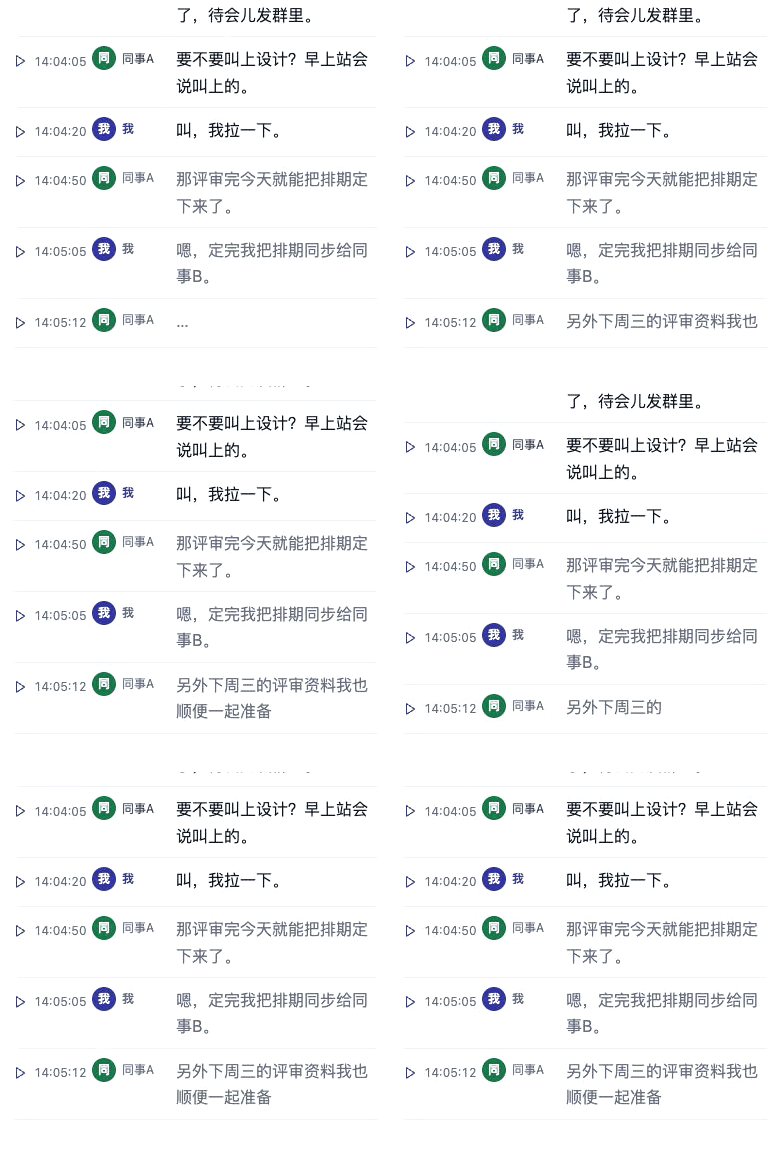
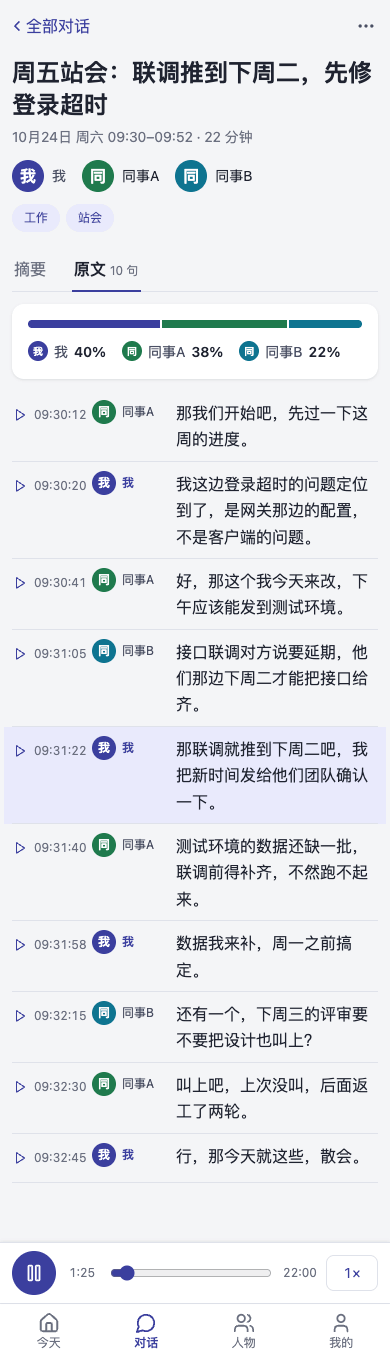
Live captions while the page is open (the draft layer). Below, the web UI on a phone, filled with made-up data (the screenshots show the Chinese UI; the web UI can be switched to English on the 「我的」 (Me) page).
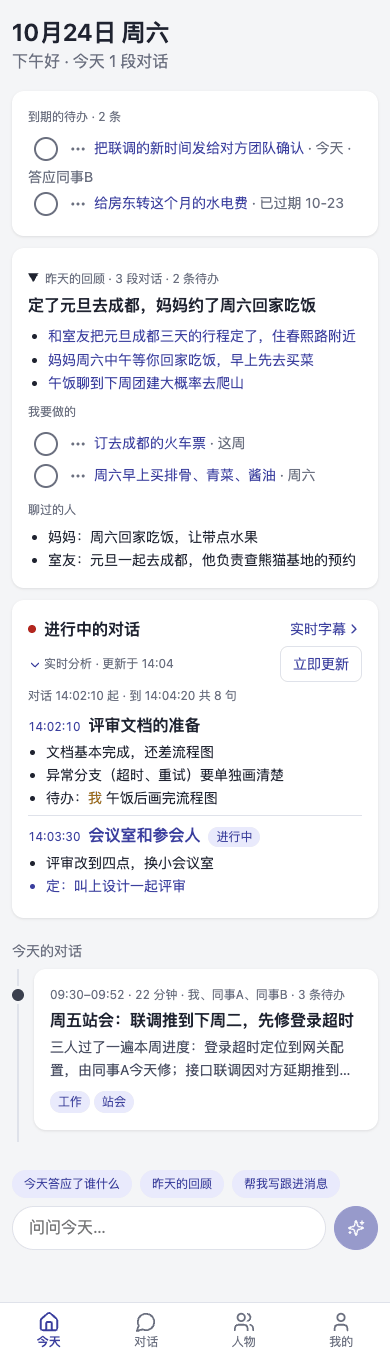 | 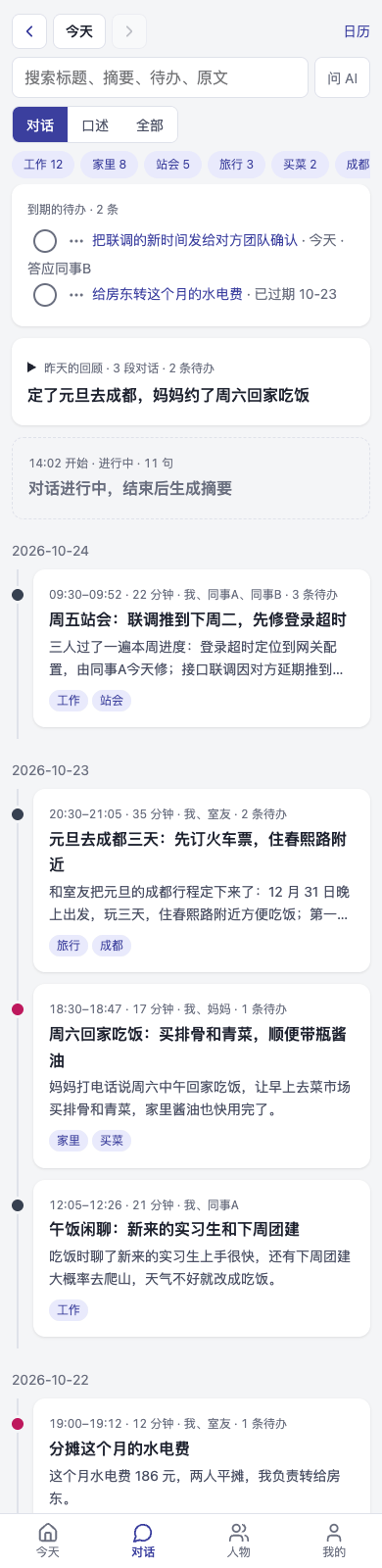 | 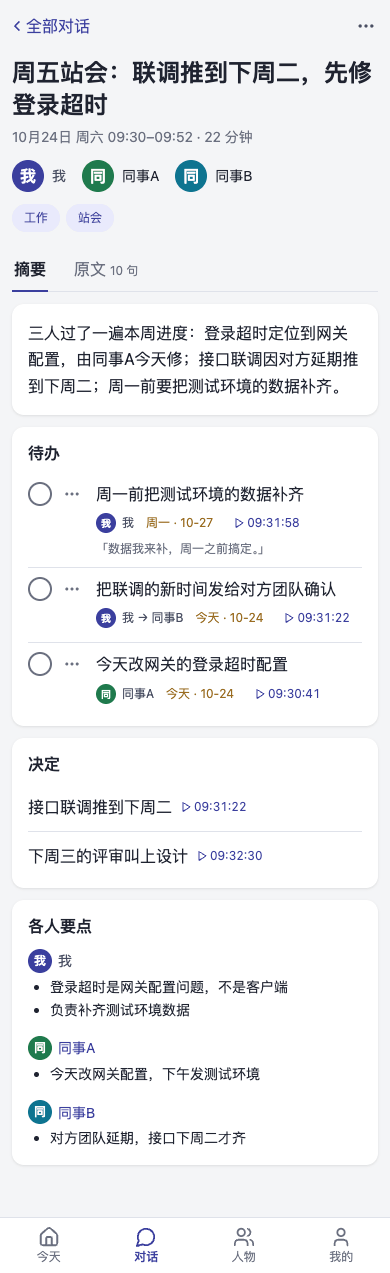 |  |
|---|---|---|---|
| Today: due to-dos, yesterday's recap, the conversation going on, today's conversations, and a box to ask about today | Conversations: titles, summaries, tags, due to-dos | One conversation's summary: to-dos, decisions, per-person points | Transcript with speakers: tap a line to play from there; the line playing is highlighted |
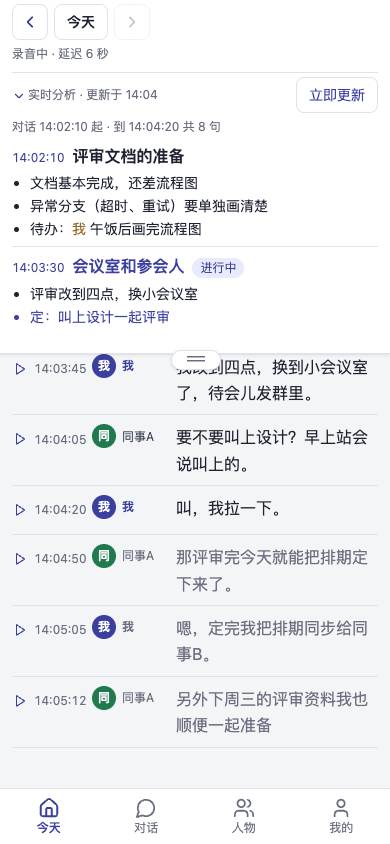 | 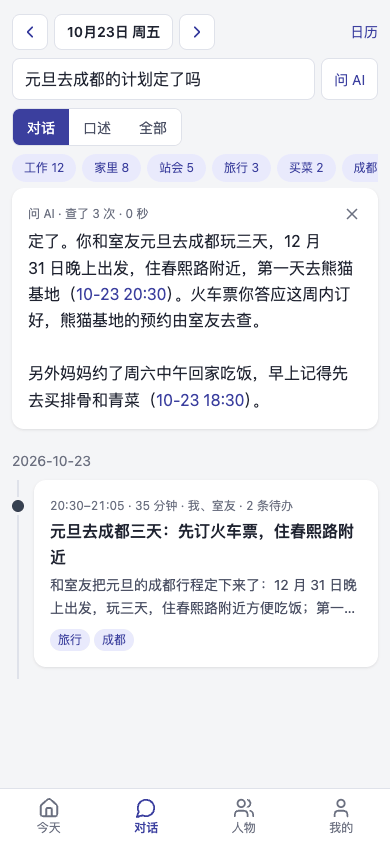 | 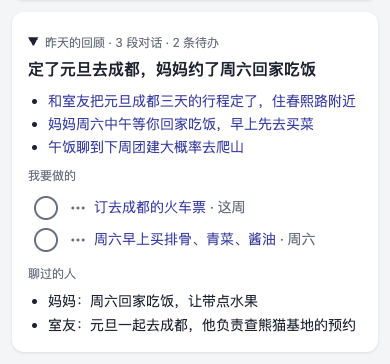 | 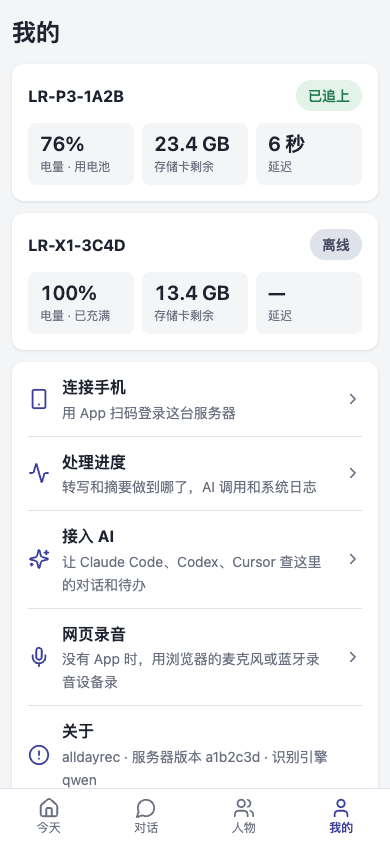 |
| Live page: the live analysis of the conversation going on, drafts as words come in | Ask AI: an answer with links to the conversations it came from | Daily recap: highlights, your to-dos, the people you talked to | Me: each recorder's battery, free card space and lag, plus links to connect a phone, see progress and hook up AI agents |
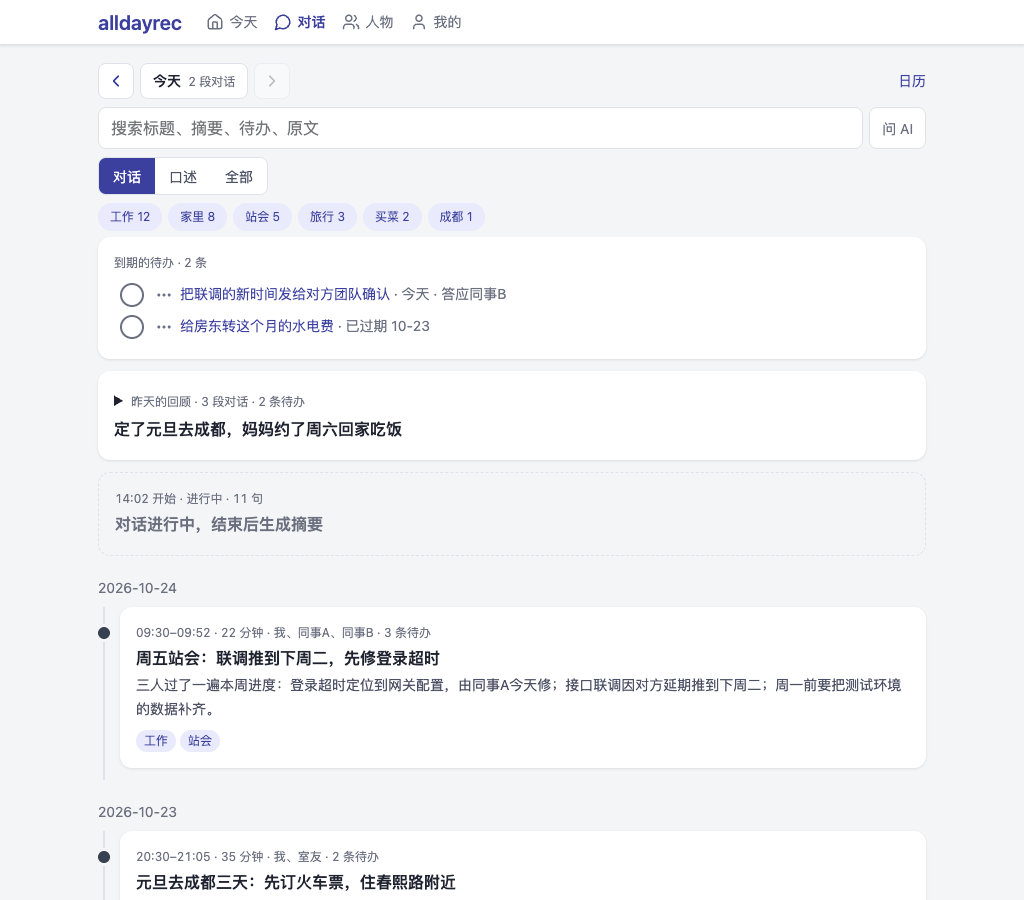
The conversations page on a desktop:
Why
- The original audio stays. OPPO's 心力球 and Bee delete the audio once it is transcribed, so a wrong transcript has nothing to be checked against. Here every line plays back, and old days can be transcribed again when a better model comes along.
- Your data lives on your server. One machine, one SQLite database and the original recordings. Audio goes only to the ASR service you pick and transcripts only to the LLM you pick; there is no account to sign up for.
- No subscription. The software is free (MIT). The default Qwen file transcription costs about ¥0.05 per hour of audio, paid to the cloud provider by use, with no monthly minute cap. The LLM costs whatever the service you pick charges.
- Any device, open hardware. The iPhone and Android app records the phone's mic; for all-day wear, solder a BLE recorder (
LR-P3) from a few off-the-shelf modules, with the parts list, wiring diagram and 3D-printed case in this repository. - Your agent can search your days. A remote MCP endpoint for Claude Code, Codex and Cursor, a CLI, and SQLite storage you can read yourself.
What it does
- Records all day. The phone app uploads short Opus pieces; a BLE recorder writes everything to its SD card and streams it to the phone, which fills gaps after a disconnection. Nothing is lost while offline: pieces queue on the device and go up later.
- Takes any audio source. Anything that can POST audio can feed the server (
POST /api/chunks), recordings you already have too: see importing. - Transcribes in two layers. The final layer cuts the audio in pauses and sends pieces of up to 5 minutes to a cloud ASR engine (default: Alibaba Cloud Bailian Qwen, about ¥0.05 per hour of audio); while a page is open, a draft layer shows words within seconds. Without an ASR key,
ENGINE=localtranscribes on your machine (compared with the cloud engines). - Knows who spoke. Speech detection (FireRedVAD) and voiceprints (ReDimNet2) run locally on onnxruntime, no GPU: it learns your own voice, keeps speakers apart within a conversation and remembers the names you give them.
- Remembers. Conversations are closed after a silence and summarized by an LLM of your choice; to-dos with due dates, a daily recap, full-text search and "ask AI" over your history, with links to the conversations an answer came from. A conversation with under 60 s of speech gets its first sentence as the title and no summary or to-dos (
MIN_SPEECH_Sinserver/alldayrec/summary.py). - Opens up. A web UI, a remote MCP endpoint (
POST /mcp) for Claude Code, Codex, Cursor and other agents, a small CLI (cli/lr.py), and SQLite storage you can read yourself. - Stays yours. One server, your disk, several people per server if you like (one token each).
How it compares
| alldayrec | Anker × Feishu AI recorder (录音豆) | OPPO AI 心力球 | DingTalk A1 | Plaud | Limitless / Bee | Omi | |
|---|---|---|---|---|---|---|---|
| Price / subscription | Free software; ASR paid by use, Qwen about ¥0.05/h; LLM extra | From ¥899; 6 months of AI credits, then ¥69/month membership[1] | ¥499 trial price, by invitation; OPPO, OnePlus and realme phones only[2][3] | ¥499 / ¥799[4]; membership ¥599 or ¥1499/year[5] | NotePin S $179[6]; free 300 min/month, Pro $17.99/month[7] | Limitless bought by Meta, no longer sold[8]; Bee $74.99 + Pro $11.99/month, US only[9] | Pendant $179 ($129 on offer); free 300 cloud min/month, Pro $269/year[10] |
| All-day wear | Yes: the phone app, or a home-built recorder that writes to its card | 8 h per charge, 32 h with the case[1:1] | 24 h of continuous recording[2:1] | A card on the back of the phone, 45 h of recording[5:1] | NotePin S about 20 h[6:1] | Bee wristband, 7 days[9:1] | Pendant |
| Keeps the original audio | Yes: every line plays back and can be transcribed again | Deleted from the device after upload, kept in the cloud; download only one by one on the Minutes web page[1:2] | No: "text only, no original audio"[2:2] | Unknown | Yes, exports MP3 / WAV[11] | Bee: no, deleted after processing[9:2] | Optional, off by default[12] |
| Where the data lives | Your own server | Feishu cloud[1:3] | OPPO's PCC private cloud[2:3] | 64 GB on the device + DingTalk cloud[5:2] | Plaud cloud[7:1] | Bee's cloud (Bee Private Compute)[9:3] | Omi cloud, or your own backend[13] |
| Speaker recognition | Local voiceprints: knows your voice, remembers the names you give | Voiceprints tell speakers apart[14] | Voiceprint tells the wearer apart[2:4] | Names after a voiceprint is registered[15] | Speakers, renamable with find & replace[16] | Unknown | Speaker identification[13:1] |
| Summaries / to-dos / recap | Summaries, to-dos with due dates, decisions, daily recap | Minutes, to-dos[14:1] | Daily summary, to-dos, projects across days[2:5] | Minutes, chapters, analysis and follow-ups[4:1] | Template summaries, to-dos[17] | Bee summaries (unlimited with Pro)[9:4] | Summaries, action items, daily recaps[18] |
| Ask AI / MCP | Ask AI with sources; remote MCP | Ask across minutes[14:2]; MCP unknown | Ask in WeChat or Feishu; MCP[2:6] | Unknown | Ask Plaud; MCP[19] | Unknown | Chat; MCP[20] |
| Open hardware | Yes (hardware/lr-p3/) | No | No | No | No | No | Yes[13:2] |
| Open source | Yes (MIT: server, web, app, firmware) | No | No | No | No | No | Yes (MIT)[13:3] |
"No" means no published design files or source code; "Unknown" means we found no reliable source. Prices and features are as of 2026-10-24; check each vendor's own site. Product names and trademarks belong to their owners; this project is not affiliated with any of them.
Name and history
"LR" / "lr" is the project's internal codename, still used in the hardware and the code: recorder names like LR-P3, the firmware tool lr.sh, the CLI lr.py.
The git history was rewritten before publishing to remove the author's private deployment details, so it is short on purpose, and references like lr#123 in commit messages point at issues of the earlier private repository, not this one.
The project is released under the MIT license. Bundled third-party code (the Omi devkit, Opus, FireRedVAD's post-processor and others) keeps its own license: see THIRD_PARTY_NOTICES.md.
igao7, Anker AI recorder review (price, AI credits and membership, battery, audio export, cloud storage), Chinese ↩︎ ↩︎ ↩︎ ↩︎
GeekPark, OPPO AI 心力球 and its 白鲸 AI app (no original audio, PCC private cloud, voiceprint, MCP, supported phones), Chinese ↩︎ ↩︎ ↩︎ ↩︎ ↩︎ ↩︎ ↩︎
GeekPark, DingTalk A1 hands-on (transcript, minutes, chapters, analysis), Chinese ↩︎ ↩︎
QbitAI, DingTalk A1 launch (price, membership, battery, storage), Chinese ↩︎ ↩︎ ↩︎
TechInformed, Meta acquires Limitless, which stops selling its pendant to new customers (2025-12-09) ↩︎
The Next Web, Amazon relaunches Bee (prices, subscription, audio deleted after processing) ↩︎ ↩︎ ↩︎ ↩︎ ↩︎
Omi docs (hardware, firmware, app and backend open source, self-hostable, speaker identification) ↩︎ ↩︎ ↩︎ ↩︎
52audio, Anker AI recorder (voiceprints, minutes and to-dos, Q&A), Chinese ↩︎ ↩︎ ↩︎
DingTalk AI Minutes (names after voiceprint registration) ↩︎
Omi's README (summaries and action items); its home page source (Daily Recaps) ↩︎